



How Your Brain Can Heal, Adapt, and Flourish at Every Stage of Life
Have you ever caught yourself thinking, “This is just who I am.” Perhaps you’ve believed you’re naturally anxious, overly sensitive, or destined to repeat the same emotional patterns.
If so, I want to gently offer you some hopeful news.
Your brain is far more adaptable than we once believed.
Modern neuroscience has revealed something remarkable: our brains continue changing throughout our lives. Every meaningful experience, supportive relationship, compassionate thought, healthy habit, and mindful pause has the potential to reshape the way our brains function.
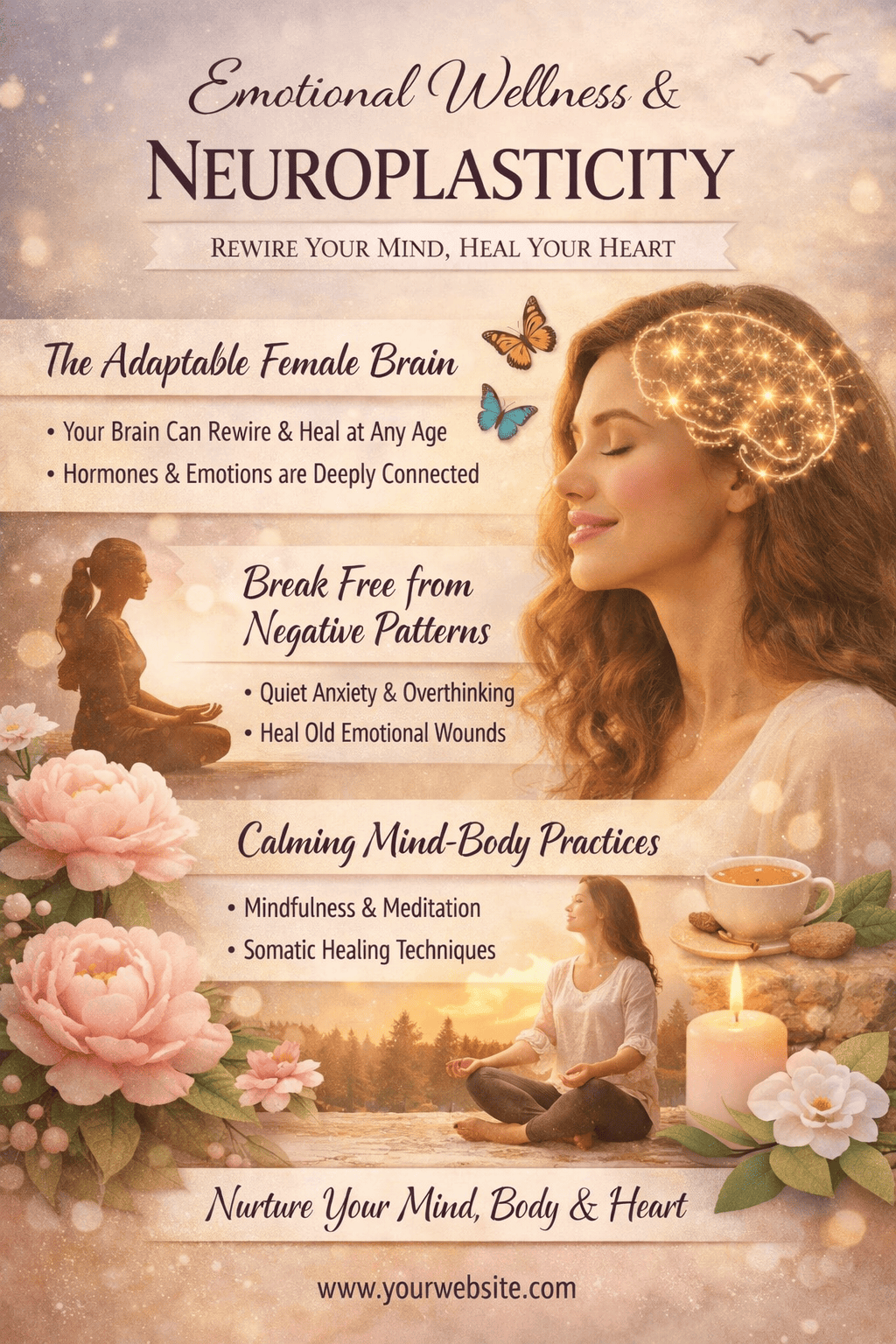
This extraordinary ability is known as neuroplasticity—the brain’s lifelong capacity to reorganize itself by forming new neural connections.
For women, neuroplasticity is especially fascinating because our brains are continually influenced by hormonal rhythms, life transitions, emotional experiences, and the demands we often carry as caregivers, professionals, mothers, daughters, partners, and friends.
The encouraging truth is this:
You are not trapped by yesterday’s stress.
You are not defined by old emotional wounds.
And you are certainly not “too old” to change.
Whether you’re navigating burnout, anxiety, perimenopause, motherhood, or simply longing to feel calmer and more emotionally resilient, your brain retains an incredible capacity for healing and growth.
Let’s explore how.
The Foundations of the Adaptable Female Brain
What Is Neuroplasticity?
Think of your brain as a beautiful forest.
Every thought, emotion, and repeated behavior is like walking along a trail.
The first time you walk a path, it is barely visible.
Walk it every day, however, and it becomes a well-worn road.
Our brains work in much the same way.
Each time we repeat a thought—whether hopeful or fearful—the neural pathway responsible becomes a little stronger.
This doesn’t mean one anxious thought permanently changes your brain.
It means consistent repetition creates stronger neural networks.
Fortunately, this works both ways.
Just as worry can become a habit, so can calm.
Just as self-criticism can become automatic, so can self-compassion.
This is the beautiful promise of neuroplasticity.
Your brain is constantly asking:
“What should I become better at?”
Whatever you practice, your brain strengthens.
The Conversation Between Emotion and Logic
Inside your brain are many remarkable regions working together.
Two are especially important for emotional wellness.
The Amygdala
Often called the brain’s “alarm system,” the amygdala rapidly detects potential danger.
Its job is protection—not happiness.
Thousands of years ago, this kept our ancestors alive.
Today, however, our brains often respond to overflowing inboxes, difficult conversations, financial uncertainty, or social rejection as though they were life-threatening events.
The amygdala cannot always distinguish between physical danger and emotional stress.
The Prefrontal Cortex
Situated behind the forehead, the prefrontal cortex acts as the brain’s thoughtful guide.
It helps us:
- make wise decisions
- regulate emotions
- solve problems
- practice empathy
- pause before reacting
- plan for the future
When we’re calm, this region functions beautifully.
When we’re overwhelmed, the amygdala often takes control.
Have you ever said something during an argument that you later regretted?
Or forgotten simple tasks when feeling anxious?
That’s your emotional brain temporarily overpowering your thinking brain.
The encouraging news?
Practices like mindfulness, slow breathing, journaling, and self-compassion strengthen the communication between these regions over time.
Your Brain Isn’t Broken—It’s Protecting You
One of the most freeing ideas in neuroscience is this:
Your brain is not working against you.
It’s working for your survival.
Many women carry guilt because they overthink, worry, people-please, or expect perfection from themselves.
Rather than asking,
“What’s wrong with me?”
perhaps we can ask,
“What has my brain learned to do in order to protect me?”
Maybe perfectionism once helped you earn praise.
Maybe people-pleasing once kept conflict away.
Maybe constant busyness once created a sense of safety.
Your brain simply repeated strategies that appeared to work.
Through neuroplasticity, we can gently teach it healthier alternatives.
Neurogenesis vs. Neuroplasticity
These two terms are often confused.
Neurogenesis
Neurogenesis is the creation of entirely new brain cells.
This happens primarily in the hippocampus—a region essential for learning and memory.
Exercise, quality sleep, and enriched environments appear to support this process.
Neuroplasticity
Neuroplasticity refers to strengthening, weakening, or reorganizing existing neural connections.
Every time you choose a new response instead of an old automatic reaction, your brain begins rewiring itself.
Think of neurogenesis as planting new trees.
Neuroplasticity is building better roads between them.
How Negative Thought Patterns Become Highways
Imagine driving down the same road every day for years.
Eventually, you know every turn without thinking.
Negative thinking develops similarly.
Repeated thoughts such as:
“I’m not good enough.”
“I always fail.”
“Everyone is judging me.”
gradually become familiar neural highways.
The good news?
Highways are not permanent.
When we repeatedly practice healthier perspectives, new pathways slowly become easier to travel.
Change rarely happens overnight.
But it absolutely happens.
🌸 Menopause Clarity Journal & Tracker Bundle
Navigate perimenopause and menopause with beautifully designed printable journals,
symptom trackers, reflection pages, and gentle wellness tools to support your journey.
Instant Download • Printable PDF • Thoughtfully Designed
The Hormonal-Neural Connection Across a Woman’s Life
Women’s brains are beautifully dynamic.
Hormones don’t simply influence reproductive health—they shape memory, mood, attention, learning, and emotional resilience.
Understanding these changes helps replace self-judgment with self-compassion.
The Monthly Dance Between Hormones and the Brain
Throughout the menstrual cycle, estrogen and progesterone naturally rise and fall.
These fluctuations influence communication between different brain networks.
Many women notice they feel:
- mentally sharper during certain weeks
- more creative around ovulation
- emotionally sensitive before menstruation
- more fatigued during hormonal shifts
These experiences are not signs of weakness.
They reflect your brain adapting to changing hormonal chemistry.
Instead of expecting identical productivity every day, we can learn to work with our body’s natural rhythm.
That is gentle living.
Estrogen: A Quiet Guardian of Brain Health
Estrogen does far more than regulate reproductive function.
It supports:
- memory formation
- emotional flexibility
- communication between neurons
- stress resilience
- healthy blood flow to the brain
As estrogen fluctuates, some women notice:
- brain fog
- forgetfulness
- increased anxiety
- sleep disturbances
- reduced concentration
Knowing that hormones influence the brain allows us to respond with kindness instead of criticism.
Perhaps you don’t need to push harder.
Perhaps your nervous system simply needs greater support.
Windows of Vulnerability—and Opportunity
Some seasons of life bring enormous brain changes.
These include:
- puberty
- pregnancy
- postpartum
- perimenopause
- menopause
While these transitions may temporarily increase emotional vulnerability, they also represent periods of heightened neuroplasticity.
Your brain is actively reorganizing itself.
That means supportive habits developed during these seasons can have especially meaningful long-term benefits.
Rather than viewing these transitions as times of loss, we might gently see them as invitations to evolve.
Perimenopause and Menopause: Your Brain Is Adapting
Many women entering their forties and fifties worry that they are “losing themselves.”
Brain fog.
Mood swings.
Poor concentration.
Interrupted sleep.
These experiences can feel unsettling.
Yet neuroscience increasingly suggests that the menopausal brain is undergoing significant reorganization rather than permanent decline.
As estrogen decreases, the brain learns to function differently.
This adaptation takes time.
During this season, gentle nervous system care becomes especially important.
Daily movement.
Protein-rich meals.
Consistent sleep.
Mindfulness.
Meaningful friendships.
Moments of joy.
These small acts become powerful investments in long-term brain health.
🌿 Explore the SproutHealth Wellness Shop
Visit SproutHealth.co
to shop our curated collection of wellness, home, beauty, fitness, and lifestyle essentials.
Discover thoughtful products designed to bring comfort, ease, and inspiration into your everyday life.
Neuroinflammation: When Stress and Hormones Collide
Chronic stress doesn’t only affect our emotions.
It influences inflammation throughout the body—including the brain.
When prolonged stress combines with hormonal fluctuations, some women become more vulnerable to anxiety, low mood, fatigue, and cognitive difficulties.
The encouraging news is that lifestyle choices matter.
Anti-inflammatory foods, restorative sleep, regular movement, stress reduction practices, and nurturing relationships all support healthier brain function.
Your brain is constantly responding to the environment you create.
Every nourishing choice sends your nervous system a message:
“You are safe.”
And safety is one of the greatest catalysts for positive neuroplastic change.
As we continue this journey, we’ll explore how burnout, perfectionism, anxiety, trauma, digital overload, and practical daily habits influence the brain—and most importantly, how gentle, consistent practices can help you consciously rewire your emotional wellbeing.
Because healing isn’t about becoming someone new.
It’s about helping your remarkable brain remember the calm, resilient, and deeply compassionate person you have always been.
Emotional Wellness & Neuroplasticity: A Gentle Guide for Women (Part 2)
The Emotional Patterns We Can Gently Rewire
By now, we’ve discovered that the brain is beautifully adaptable. But what does this mean in everyday life?
It means that even if you’ve lived with anxiety for years, struggled with perfectionism, or felt trapped in cycles of burnout, your story isn’t finished.
Neuroplasticity offers hope—not because change happens overnight, but because every compassionate choice you make today becomes a vote for the person you are becoming tomorrow.
Let’s look at some of the most common emotional struggles women experience and how understanding the brain can help us respond with greater wisdom and gentleness.
Burnout: When Your Brain Is Running on Empty
Burnout is far more than feeling tired after a busy week.
It is a state of physical, emotional, and mental exhaustion caused by prolonged stress without enough recovery.
For many women, burnout develops quietly.
You keep saying yes.
You care for everyone else.
You juggle work, family, friendships, household responsibilities, and countless invisible tasks.
Eventually, your nervous system begins operating in survival mode.
Research suggests that chronic stress increases cortisol, the body’s primary stress hormone. Over time, elevated cortisol can affect areas of the brain involved in memory, emotional regulation, and decision-making. Some studies even show temporary shrinkage of dendrites—the tiny branches that help brain cells communicate—when stress becomes prolonged.
The encouraging news is that the brain can recover.
Every time you choose rest without guilt, step outside for fresh air, take a mindful walk, or simply pause for five minutes of intentional breathing, you are giving your nervous system permission to repair.
One of the greatest gifts you can offer yourself is to remember this:
Rest is not the reward for productivity. Rest is part of productivity.
The Inner Critic: Rewriting the Voice Inside Your Mind
Many women carry an inner voice that sounds more like a harsh supervisor than a trusted friend.
“You should be doing more.”
“You’re falling behind.”
“You’re not good enough.”
This inner critic often develops over years of repeated experiences, cultural expectations, childhood messages, and perfectionistic habits.
Because these thoughts are repeated so often, they become deeply familiar neural pathways.
Thankfully, familiarity does not equal truth.
One of the most effective ways to weaken the inner critic is through self-compassion.
Instead of asking,
“Why am I like this?”
try asking,
“What would I say to someone I love who was feeling this way?”
This simple shift activates different areas of the brain associated with empathy and emotional regulation.
Over time, compassionate self-talk becomes easier because you are literally strengthening new neural connections.
Remember one of our guiding principles at Holistic Wellness Hub:
Progress grows through compassion, not criticism.
Anxiety: Understanding Your Brain’s Alarm System
Anxiety is often misunderstood.
Many people assume anxious individuals are weak or simply “overthinking.”
In reality, anxiety reflects an incredibly efficient survival system.
The amygdala has become highly sensitive, detecting possible danger everywhere.
Emails.
Phone calls.
Unexpected changes.
Health concerns.
Financial uncertainty.
Social interactions.
Your brain is trying to keep you safe.
The goal is not to eliminate the amygdala.
The goal is to reassure it.
This is where nervous system regulation becomes so powerful.
When we repeatedly practice calm breathing, mindfulness, grounding exercises, and safe social connection, the brain gradually learns that not every uncertainty requires an emergency response.
Little by little, the alarm becomes quieter.
Trauma and the Possibility of Healing
Trauma is not only about what happened.
It is also about how our nervous system adapted in order to survive.
Some experiences become stored with intense emotional charge.
The brain repeatedly revisits them because it believes the danger remains unresolved.
Fortunately, the brain also possesses the remarkable ability to update emotional memories.
This process, known as memory reconsolidation, allows previously distressing experiences to be integrated in healthier ways—often with the support of trauma-informed therapists, compassionate relationships, mindfulness, and gentle body-based practices.
Healing from trauma does not mean forgetting.
It means remembering without remaining trapped inside the emotional intensity.
If you have experienced significant trauma, please know you do not have to navigate healing alone. Seeking support is a sign of courage, not weakness.
The Dopamine Deception: Why Endless Scrolling Leaves Us Drained
Modern technology is designed to capture attention.
Every notification, “like,” and short video offers a tiny burst of dopamine—the brain’s reward chemical.
While dopamine itself isn’t harmful, constant stimulation can train the brain to expect frequent novelty.
As a result, quieter activities like reading, prayer, journaling, or simply sitting with our thoughts may begin to feel difficult.
Rather than blaming ourselves for this habit, we can gently retrain our brains.
Consider creating small “digital sunsets” by putting away devices thirty minutes before bedtime.
Replace five minutes of scrolling with five minutes of stretching.
Choose one meal each day without a screen.
Tiny shifts create lasting change.
Your Gentle Toolkit for Rewiring the Brain
Neuroplasticity isn’t about dramatic transformations.
It’s about consistent, intentional practice.
Here are some simple ways to support your brain every day.
1. Cognitive Reappraisal
Our emotions are influenced not only by what happens but also by how we interpret what happens.
Imagine receiving constructive feedback.
One interpretation might be:
“I’m failing.”
Another could be:
“I’m learning.”
The situation hasn’t changed.
Your interpretation has.
This gentle mental shift activates the prefrontal cortex, helping calm emotional reactivity and encouraging flexible thinking.
2. Somatic Anchoring
The body often calms the brain faster than the mind can.
When anxiety rises, try one of these simple practices:
- Feel both feet firmly on the floor.
- Slowly name five things you can see.
- Place one hand over your heart and one over your abdomen.
- Practice slow breathing with a longer exhale.
- Try gentle bilateral tapping by alternating light taps on each shoulder or thigh.
These techniques send signals of safety throughout the nervous system.
3. Mindfulness and Meditation
Mindfulness is not about emptying the mind.
It is about noticing thoughts without becoming trapped by them.
Research has shown that regular meditation may strengthen areas involved in attention and emotional regulation while reducing overactivity in the brain’s fear circuits.
You don’t need an hour.
Begin with five peaceful minutes.
Consistency matters more than duration.
4. Healing Through Journaling
Writing allows thoughts that feel tangled inside the mind to become clearer on paper.
Journaling helps integrate emotional experiences with logical understanding.
Some gentle prompts include:
- What emotion am I experiencing today?
- What does my body need right now?
- What am I grateful for?
- What story am I telling myself?
- Is there another compassionate perspective?
Your journal does not need perfect grammar.
It simply needs honesty.
5. The Five-Minute Rule
One of the greatest myths in personal development is that change requires enormous effort.
In reality, tiny consistent habits reshape the brain more effectively than occasional bursts of motivation.
Five minutes of meditation.
Five minutes of stretching.
Five minutes of gratitude.
Five minutes of prayer.
Five minutes of reading.
Small daily actions become powerful neural investments.
As I often remind our Holistic Wellness Hub community:
Choose presence over perfection.
Lifestyle Habits That Support a Healthy Brain
Move Your Body
Gentle movement stimulates the release of Brain-Derived Neurotrophic Factor (BDNF), often called “fertilizer for the brain.”
Walking, dancing, cycling, yoga, swimming, or gardening all encourage learning and resilience.
You don’t need intense workouts.
You simply need joyful movement.
Protect Your Sleep
Sleep is when your brain organizes memories, regulates emotions, clears metabolic waste, and strengthens newly formed neural pathways.
Rather than viewing sleep as wasted time, think of it as your brain’s overnight healing session.
Aim for a consistent bedtime whenever possible.
Prioritize Connection
Humans are designed for connection.
Meaningful conversations, supportive friendships, hugs from loved ones, laughter, shared meals, and acts of kindness all stimulate oxytocin—the hormone associated with trust and bonding.
Healing rarely happens in complete isolation.
Sometimes the most powerful medicine is simply feeling understood.
Nourish Your Brain
Your brain depends upon the nutrients you provide.
Choose foods that support both your gut and your nervous system, including:
- colourful fruits and vegetables
- leafy greens
- berries
- nuts and seeds
- oily fish or plant-based omega-3 sources
- legumes
- whole grains
- fermented foods
- adequate hydration
Rather than focusing on restriction, focus on nourishment.
Every meal becomes another opportunity to care for your future self.
Frequently Asked Questions
Can my brain really change after 40 or 50?
Absolutely.
Although learning may occur differently than during childhood, neuroplasticity continues throughout life. Healthy habits, meaningful relationships, mental stimulation, physical activity, and emotional wellbeing all support lifelong brain adaptation.
How long does it take to change negative thought patterns?
There is no universal timeline.
Some people notice subtle improvements within a few weeks, while deeper emotional patterns may take several months of consistent practice.
Be patient with yourself.
You’re building new pathways one day at a time.
Is PMS a sign that something is wrong with my brain?
No.
Hormonal fluctuations naturally influence emotional processing and stress sensitivity during different phases of the menstrual cycle.
Experiencing emotional shifts does not mean your brain is broken.
It means your body is moving through a normal biological rhythm.
What’s the quickest way to calm anxiety?
Ground yourself through the body first.
Slow breathing, feeling your feet against the floor, gentle bilateral tapping, progressive muscle relaxation, or stepping outside for fresh air can quickly reduce nervous system activation.
Why is sleep so important for emotional wellness?
Sleep helps consolidate learning, regulate emotions, strengthen healthy neural pathways, and prepare the brain for another day of adaptation.
Without adequate sleep, emotional regulation becomes significantly more difficult.
A Gentle Invitation to Begin
Perhaps the most beautiful lesson from neuroplasticity is this:
You are never truly stuck.
Every compassionate thought.
Every mindful breath.
Every nourishing meal.
Every quiet prayer.
Every boundary you honour.
Every journal page you write.
Every walk you take.
Every night you choose rest.
Every act of kindness toward yourself.
These seemingly ordinary moments are quietly shaping the extraordinary landscape of your brain.
At Holistic Wellness Hub, we believe healing isn’t about becoming someone else.
It’s about gently uncovering the resilient, compassionate, and whole person God created you to be.
May you release the pressure to change overnight.
May you embrace small, sustainable steps.
And may you remember that your brain—and your heart—are wonderfully designed for hope, healing, and lifelong growth.
Gentle Next Steps
If this article encouraged you, you may also enjoy exploring our free wellness journals and mindful living resources designed to help you cultivate emotional resilience one gentle step at a time.
Remember:
Permission over Perfection.
Energy over Efficiency.
Presence over Productivity.
Your healing journey doesn’t begin when life becomes perfect.
It begins with one small, compassionate choice today.