

Your periods have started to behave like a moody teenager. Your sleep is lighter than it used to be. You walk into a room and forget why. And somewhere between the hot flush in the supermarket queue and the 3 AM wake-up, one question keeps coming back: is this perimenopause, or is this menopause?
If you feel confused, you are in very good company. Most of us were never taught the difference. The words are used as if they mean the same thing, and many appointments end with a vague “it’s just your age.” But perimenopause and menopause are two different stages. They have different timing, different symptoms and, sometimes, different ways of helping you feel like yourself again.
In this guide I’ll walk you through the real differences in plain, friendly language. I’ll share what large research studies have actually found, explain the newest treatment news, and offer simple ways to support yourself right now. Pour a cup of tea, and let’s make this a little less confusing together.
Key takeaways
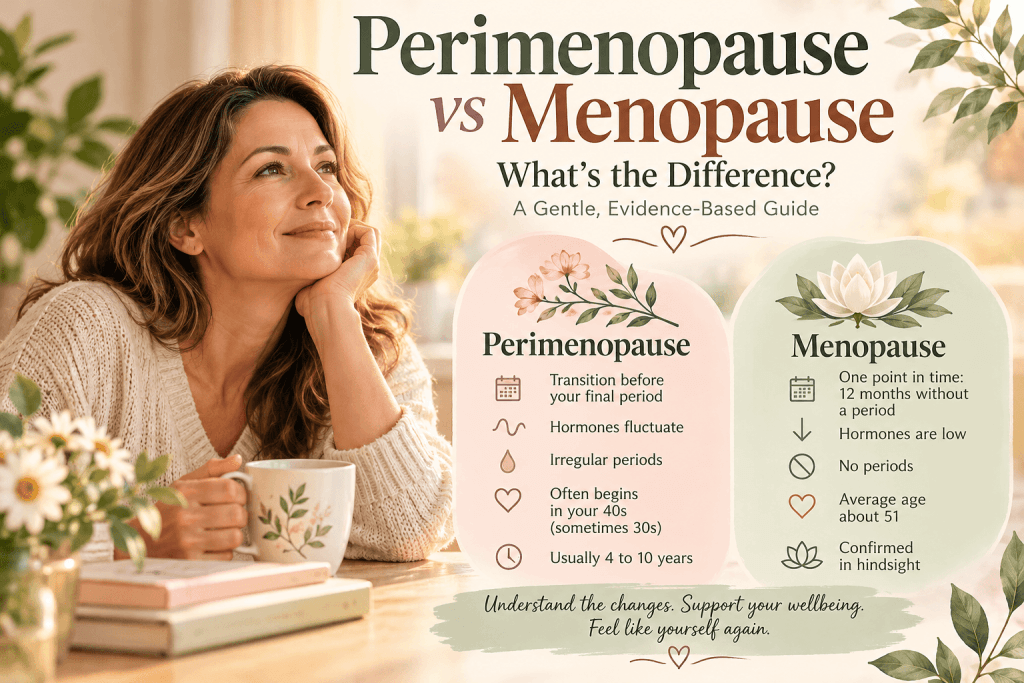
- Perimenopause is the transition before your final period. Menopause is a single point in time: the day you have gone 12 months without a period.
- Perimenopause often begins in your 40s (sometimes in your late 30s) and is commonly described as lasting 4 to 10 years. The average age of menopause in the US is about 51.
- You can still get pregnant during perimenopause.
- Hot flashes (hot flushes in the UK and Australia) can last much longer than most of us were told: a median of 7.4 years in a large US study.
- If you are over 45 with typical symptoms, you usually do not need a hormone blood test to know where you are.
- There are more treatment options now than a few years ago, including newer non-hormonal medicines and updated hormone therapy labelling in the US.
The Short Answer: Perimenopause vs Menopause
Perimenopause means “around menopause.” It is the transition phase when your hormones begin to fluctuate and your ovaries slowly wind down. Your periods are still happening, but they are changing, and so are many other things about how you feel.
Menopause is not a long stage at all. It is one moment, recognised only in hindsight: the point when you realise 12 months have passed since your last period. Doctors call it a retrospective diagnosis, because nobody can know in advance that a period was the final one.
Postmenopause is every year after that, for the rest of your life.
So when a friend says “I’m going through menopause” while she is still having irregular periods and night sweats, she is almost always in perimenopause. It is an easy mix-up, and it is exactly why searching online can feel so overwhelming.
Perimenopause vs Menopause at a Glance
| Perimenopause | Menopause | Postmenopause | |
|---|---|---|---|
| What it is | The transition leading up to your final period | One point in time: 12 months with no period | All the years after menopause |
| Typical age | Often from the early 40s, sometimes the late 30s | Average about 51 in the US; usually between 45 and 55 | From about 51 onward |
| Periods | Irregular: shorter, longer, heavier, lighter or skipped | None for 12 months in a row | None (any bleeding should be checked) |
| Pregnancy possible? | Yes, less predictable but still possible | No, once confirmed | No |
| Hormones | Estrogen and progesterone swing up and down | Estrogen and progesterone are low | Stay low |
| Common symptoms | Hot flashes, sleep trouble, mood changes, brain fog, heavy or irregular bleeding | Hot flashes may continue; vaginal dryness; urinary changes | Hot flashes can linger; bone and heart health matter more |
| How it’s confirmed | Usually by your age, symptoms and cycle changes | After 12 months without a period | Already confirmed |
| How long | Commonly 4 to 10 years; can be shorter or longer | A single point in time | The rest of life |
What Is Perimenopause?
Think of your hormones in your twenties and thirties as a well-rehearsed orchestra. Estrogen and progesterone rise and fall in a predictable monthly pattern. In perimenopause, the ovaries become less predictable. Estrogen can swing higher on some days and lower on others, and ovulation becomes irregular. It is these ups and downs, more than simply “low hormones,” that explain why symptoms can feel so random: calm and clear one week, tearful and foggy the next.
Many women notice the first changes in their 40s, and some begin in their late 30s. Doctors at Houston Methodist describe perimenopausal symptoms starting anywhere from about three to seven years before the final period, and the Menopause Society describes perimenopause as lasting about 4 to 10 years on average, though it can be shorter or longer.
The word that matters most here is variable. Your mother’s, your sister’s, and your best friend’s experience will not be a map of yours. If you want a closer look at early clues, I’ve written about them in Perimenopause in Your 40s: Early Signs Most Women Miss.
Common Signs of Perimenopause
You do not need to have every symptom. Many women notice only two or three. These are the ones that come up most often:
- Changes in your period. This is often the earliest and clearest sign. Cycles may become shorter, longer, heavier, lighter, or skip a month or two and then return.
- Hot flashes and night sweats. These can begin while your periods are still fairly regular. If they affect you, my post on hot flashes and inflammation goes deeper.
- Sleep trouble. Waking in the small hours is very common. I explain why in Why You’re Waking Up at 3AM in Midlife.
- Mood changes. Irritability, anxiety, low mood or feeling “not like myself.”
- Brain fog. Losing words, misplacing things, struggling to concentrate.
- Vaginal and urinary changes. Dryness, discomfort, lower desire, or needing the bathroom more often.
- Other changes. Headaches or migraines, breast tenderness, joint aches, a racing heart, and shifts in weight, skin and hair.
Because these symptoms overlap with other conditions (thyroid problems and low iron are two common examples), it is always worth telling your doctor what you are noticing rather than assuming. A simple daily log makes that conversation much easier. Here’s a gentle method: how to start tracking your perimenopause symptoms.
What Is Menopause (and Postmenopause)?
Menopause is the end of your menstrual cycles. In the US, the average age is around 51, and most women reach it naturally between 45 and 55. A final period before 45 is called early menopause, and menopause before 40 is known as premature ovarian insufficiency. Genetics, smoking, and certain medical treatments such as some cancer therapies or surgery to remove the ovaries can bring it earlier.
Once you are postmenopausal, your periods are gone, but your story is not over. Hot flashes can continue for years. Vaginal dryness and urinary symptoms often persist or become more noticeable without treatment. And because estrogen helps protect bones and supports heart health, these two areas deserve more attention after menopause. (There is more on bones below, and in my guide to maintaining bone health as you age.)
What the Research Actually Says
I love a gentle explanation, but I also like evidence. Much of what we know about the menopause transition comes from SWAN, the Study of Women’s Health Across the Nation, a long-running US study that has followed thousands of midlife women. Here are four findings that I think every woman should know about.
1. Hot flashes can last longer than we were told
For years, many women were told that hot flashes pass in a year or two. A 2015 SWAN analysis led by Nancy Avis, published in JAMA Internal Medicine, found otherwise. Among 1,449 women who had frequent hot flashes or night sweats, the median total duration was 7.4 years, and for those with a clearly identified final period, symptoms continued a median of 4.5 years after it.
Timing mattered too. Women whose hot flashes began early, while they were still premenopausal or in early perimenopause, had the longest course: more than 11.8 years in total. Those whose hot flashes only started after menopause had the shortest, about 3.4 years. The study also found differences between groups. Black women reported the longest median duration (10.1 years), followed by Hispanic women (8.9 years), white women (6.5 years), Chinese women (5.4 years) and Japanese women (4.8 years). The researchers could not fully explain why.
What this means for you: if your symptoms are lasting longer than you expected, you are not imagining it, and you are not failing at “getting through it.” It is also a good reason to seek support rather than simply wait it out.
2. The transition can be a vulnerable time for mood
Two landmark studies published in 2006 in Archives of General Psychiatry looked at mood in women with no history of depression. In the Harvard Study of Moods and Cycles, led by Lee Cohen, women who entered perimenopause were about twice as likely to develop significant depressive symptoms as women who stayed premenopausal. The risk was higher in women who had hot flashes and in those facing stressful life events. A second study by Ellen Freeman and colleagues found that factors such as premenstrual symptoms and life stress also played a role.
What this means for you: if you feel more anxious, tearful, or flat than usual, it is not weakness, and it is not “all in your head.” Hormonal change, poor sleep, and life pressure can pile up together. Please speak to someone about it, and if you ever have thoughts of harming yourself, seek help immediately (call your local emergency number or a crisis line).
3. Brain fog is real, and for most women it is temporary
In a 2009 SWAN study in Neurology, Gail Greendale and colleagues followed about 2,300 women through the transition and measured memory and thinking with objective tests. They found that women did not improve on learning-type tasks during perimenopause the way they did before and after. In other words, the trouble with learning new information was measurable. The encouraging part: performance rebounded after menopause, suggesting these difficulties are often time-limited.
What this means for you: forgetting a word or a name does not mean something is seriously wrong. Sleep, stress and hot flashes all feed brain fog, so supporting those can help. If memory problems are severe or worsening quickly, ask your doctor to look into it.
4. Bone loss speeds up around your last period
Another SWAN study, by Gail Greendale and colleagues in the Journal of Bone and Mineral Research (2012), tracked bone density in relation to the final menstrual period. Bone loss began about one year before the final period, and the fastest loss happened from one year before to two years after it. Later SWAN analyses found that women lose, on average, roughly 6 to 7 per cent of their bone density in the lumbar spine and femoral neck over the three years around the final period.
What this means for you: this is why bone-friendly habits matter in your 40s, not just later. Strength training, enough protein, calcium and vitamin D, not smoking, and limiting alcohol all help, and your doctor can advise you on whether a bone density scan makes sense for you.
A note on these studies: SWAN is observational and mostly describes US women, so it shows patterns, not guarantees. Your own body may follow a different path.
Do You Need a Test to Know?
Usually, no. If you are over 45 and have typical symptoms and changing periods, doctors can generally recognise perimenopause from your age, your history and your symptoms. Hormone levels such as FSH and estradiol swing from day to day in perimenopause, so a single blood test can look “normal” even when you feel anything but. For the same reason, at-home hormone kits are rarely helpful for answering “am I in perimenopause?”
Testing is more useful if you are under 45, if your symptoms do not fit the usual picture, or if your doctor wants to rule out other causes such as a thyroid problem, anaemia or pregnancy.
Can You Still Get Pregnant in Perimenopause?
Yes. Ovulation becomes less predictable, and fertility declines, but pregnancy remains possible until menopause is confirmed. If you do not want to conceive, ask your doctor how long you should keep using contraception. The answer depends on your age and the method you use.
Treatment Options: What Has Changed Lately
The treatment landscape has shifted a lot in the past couple of years. Here is a calm overview. Your own choice should always be made together with your doctor.
Hormone therapy (HRT)
Hormone therapy (called HRT in the UK and Australia and MHT in the US) replaces some of the estrogen, and sometimes progesterone, your body is no longer producing. It is the most effective treatment for hot flashes and night sweats, and it also helps with vaginal symptoms and protects bone.
For two decades, many women avoided it because of warnings added after the 2002 Women’s Health Initiative study. On 10 November 2025, the US FDA announced it was starting to remove the broad boxed warnings from menopausal hormone therapy labels, including language about heart disease, breast cancer and probable dementia. The boxed warning about endometrial cancer for estrogen-alone products stays. The announcement was welcomed by many doctors, and the agencies pointed to evidence that starting hormone therapy within ten years of menopause, or before age 60, may carry lower risks. Some experts have noted that the decision was made without the usual advisory committee process, so the discussion is ongoing.
The honest takeaway: hormone therapy is not right for everyone, and it is not off-limits for everyone either. Your age, how long since your last period, and your personal and family history of breast cancer, blood clots and heart disease all matter. If you are curious about the different types, read my post on the pros and cons of bioidentical hormone therapy.
Non-hormonal medicines
If you cannot or prefer not to use hormones, there are newer options. Fezolinetant (Veozah) was approved by the FDA in 2023, and elinzanetant (Lynkuet) followed on 24 October 2025. Both work on the brain’s temperature-control pathway and are approved for moderate to severe hot flashes. In trials, fezolinetant reduced hot flash frequency by nearly 60 per cent. Doctors also sometimes prescribe low-dose antidepressants or gabapentin for hot flashes and night sweats, and cognitive behavioural therapy has helped many women cope with them. Availability and approvals differ between countries, and some of these medicines need safety monitoring, so your doctor can tell you what is suitable where you live.
Gentle everyday support
Lifestyle changes will not cure perimenopause, but many women find they take the edge off. These are the ones I come back to again and again:
- Protect your sleep. Keep the bedroom cool, wear breathable fabrics, and keep a steady bedtime. My 3 AM sleep guide has a simple evening routine.
- Move your body, and lift something. Walking is wonderful. Add strength training twice a week to support your bones and muscles.
- Notice your triggers. For some women alcohol, caffeine, spicy food or stress set off hot flashes. A symptom diary shows you your own pattern.
- Calm your nervous system. Slow breathing, gentle stretching, time outdoors and short pauses in the day all help. See nervous system regulation for women 40+.
- Eat in a way that steadies you. Regular meals with protein and fibre can help with energy and mood. I share more in gut health and menopause.
- Track and talk. Bringing a few weeks of notes to your appointment makes you feel heard and helps your doctor make better decisions.
If you would like a ready-made way to track your symptoms, our own Menopause Clarity Tracker Bundle on Etsy includes printable pages for symptoms, sleep, and mood, and you can also download our free wellness journals.
When to See a Doctor
Perimenopause is natural, but you do not have to push through anything that worries you. Please make an appointment if you notice:
- Periods that come closer than 21 days apart, or bleeding that lasts longer than 7 days
- Very heavy bleeding, such as soaking through a pad or tampon every hour, or passing large clots
- Bleeding between periods or after sex
- Any bleeding after you have gone 12 months without a period
- Symptoms that begin before age 40 (or a final period before 45)
- Mood changes that are heavy, last more than a couple of weeks, or make daily life hard
- Sleep problems, hot flashes or brain fog that are affecting your work, relationships or safety
Please seek urgent help for chest pain, severe shortness of breath or any thoughts of harming yourself.
Frequently Asked Questions
What is the main difference between perimenopause and menopause?
Perimenopause is the transition before your final period, when hormones fluctuate and periods become irregular. Menopause is a single point in time, confirmed after 12 months with no period. Everything after that is postmenopause.
At what age does perimenopause start?
Most women notice changes in their 40s, and some in their late 30s. There is no single “right” age, and it often begins several years before the final period.
How long does perimenopause last?
It is commonly described as lasting 4 to 10 years, though it can be shorter or longer. Symptoms such as hot flashes can continue for years beyond that: the SWAN study found a median of 7.4 years in total.
Can you have hot flashes before your periods change?
Yes. Many women notice hot flashes or night sweats while their periods are still fairly regular. Starting early can mean a longer course, which is one more reason to seek support early.
Do symptoms stop after menopause?
Not always. In the SWAN analysis, women with a clear final period had hot flashes for a median of 4.5 further years afterward. Vaginal and urinary symptoms can also continue or worsen without treatment.
Is anxiety a symptom of perimenopause?
It can be. Hormonal changes, disrupted sleep and life stress can all raise anxiety during the transition. If anxiety feels constant or overwhelming, please talk to your doctor, because there is effective help available.
How do I know if it is perimenopause or something else?
Many conditions, including thyroid problems and anaemia, can mimic perimenopause. If you are over 45 with typical symptoms, perimenopause is likely, but a quick check-up can rule out other causes and give you peace of mind.
Do I need hormone therapy?
Not everyone does. Hormone therapy is the most effective treatment for hot flashes and night sweats, but there are also non-hormonal medicines and lifestyle approaches. The best choice depends on your symptoms, your age and your health history, so talk it through with your doctor.
A Gentle Closing
If there is one thing I would love you to take from this post, it is that you are not “going mad” and you are not behind. Perimenopause is a real, well-studied transition, and understanding the difference between perimenopause and menopause gives you a map. With a map, you can ask better questions, notice your own patterns and choose the support that suits you.
Be patient with yourself. Rest when you can. Ask for help when you need it. And remember that this season, however confusing it feels today, is also a doorway to a calmer, wiser chapter.
If you would like to keep learning, start with our Complete Guide to Perimenopause and Menopause, and join our gentle newsletter for new guides and free printables.
References
- Avis NE, Crawford SL, Greendale G, et al. Duration of menopausal vasomotor symptoms over the menopause transition. JAMA Internal Medicine. 2015;175(4):531-539. Read the study
- Cohen LS, Soares CN, Vitonis AF, Otto MW, Harlow BL. Risk for new onset of depression during the menopausal transition: the Harvard Study of Moods and Cycles. Archives of General Psychiatry. 2006;63(4):385-390.
- Freeman EW, Sammel MD, Lin H, et al. Associations of hormones and menopausal status with depressed mood in women with no history of depression. Archives of General Psychiatry. 2006;63(4):375-382.
- Greendale GA, Huang MH, Wight RG, et al. Effects of the menopause transition and hormone use on cognitive performance in midlife women. Neurology. 2009;72(21):1850-1857.
- Greendale GA, Sowers M, Han W, et al. Bone mineral density loss in relation to the final menstrual period in a multiethnic cohort: results from SWAN. Journal of Bone and Mineral Research. 2012;27(1):111-118. Read the study
- The Menopause Society. Perimenopause. letstalkmenopause.org/peri
- Houston Methodist. When does menopause usually start? houstonmethodist.org
- US Food and Drug Administration announcement on menopausal hormone therapy labelling, 10 November 2025, as reported by the Regulatory Affairs Professionals Society. raps.org
- Contemporary OB/GYN. New nonhormonal therapies transform hot flash treatment in menopause (fezolinetant and elinzanetant approvals), December 2025. contemporaryobgyn.net
This article is for general information and gentle support, not medical advice. If your symptoms are severe or worrying, please speak with your healthcare provider.