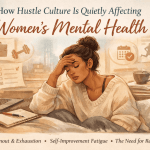


We live in a world that tracks everything.
Our steps.
Our sleep.
Our calories.
Our productivity.
Even our moods.
Every corner of life can now be measured, improved, and optimized.
But what happens when optimization starts to feel like oppression?
There comes a moment in many women’s lives — especially in midlife — when the endless striving suddenly feels too heavy to carry. A quiet pause arrives, not because we planned it, but because our spirit insists on it.
I’ve lived through that moment myself.
For years, I believed that if I could just optimize a little more — my routines, my productivity, my habits, my body, my emotions — I would finally feel “enough.”
But optimization never ends. It simply moves the finish line.
It whispers that peace is one more upgrade away.
And then I discovered something quietly rising around the world:
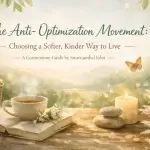
The anti-optimization movement.
A cultural shift — and a response to hustle culture burnout — that says:
You don’t have to perfect your life to live it.
You don’t have to constantly improve yourself to be worthy.
You don’t have to optimize every moment to feel fulfilled.
This is your gentle guide to understanding the anti-optimization movement — and perhaps recognizing yourself inside it.
1. What Is the Anti-Optimization Movement?
The anti-optimization movement is a growing cultural shift away from the pressure to constantly maximize, improve, and perfect every part of life.
It is not laziness.
It is humanity.
It pushes back against:
-
Hustle culture
-
Productivity obsession
-
Self-improvement overload
-
Perfectionism disguised as “growth”
-
The belief that rest must be earned
Instead, it embraces:
-
Slow living for women
-
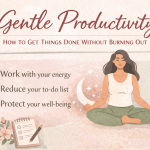
Gentle productivity
-
Self-compassion
-
Doing less, but living more
It is part of what many now call the “soft life philosophy” — a choice to live intentionally rather than urgently.
Writers like Greg McKeown in Essentialism have explored doing less but better.
Brené Brown, through The Gifts of Imperfection, reminds us that worthiness doesn’t come from performance.
More recently, Cal Newport introduced the idea of slower, sustainable work in Slow Productivity.
The anti-optimization movement is not a rebellion of noise.
It is a rebellion of softness.
2. Why Are So Many Women Rejecting Constant Optimization?
Because optimization culture has quietly become exhausting.
We live in an era of metrics:
-
Steps counted
-
Calories tracked
-
Habits monitored
-
Productivity measured
-
Success quantified
Even rest has become something to “hack.”
For women — especially those navigating midlife, perimenopause, and menopause — this pressure can intensify emotional overwhelm.
Common reasons women are embracing a gentler way of living:
• Burnout from Hustle Culture
The constant need to achieve leads to emotional depletion.
• Self-Improvement Fatigue
When every flaw becomes a “project,” life stops feeling like life.
• Rising Mental Health Awareness
Conversations around burnout recovery for women are more open and honest than ever.
• Midlife Shifts
As hormones change, energy changes. The body begins asking for softness.
• The Realization That Optimization Never Ends
There is always another routine to perfect. Another habit to install. Another version of yourself to chase.
The anti-optimization movement offers a quiet exhale.
A return to being instead of constantly becoming.
Visit SproutHealth.co to shop our curated collection of wellness, home, beauty, fitness, and lifestyle essentials. Discover products that bring comfort, ease, and inspiration into your everyday life.
3. A Personal Reflection: My Own Shift Toward Softness
I didn’t set out to reject optimization.
I simply became tired.
There was a season when I was trying to optimize everything — my routines, my emotions, my productivity, even my healing. I believed if I could just “fix” myself enough, peace would follow.
But peace doesn’t come from perfection.
It comes from permission.
Permission to rest.
Permission to slow down.
Permission to be imperfect.
Permission to be human.
The day I stopped trying to optimize myself was the day I began to feel like myself again.
Softness is not weakness.
Softness is wisdom.

4. The Rise of Slow Living and Gentle Productivity
The anti-optimization movement is deeply intertwined with the gentle living lifestyle.
Slow living encourages:
-
Savoring moments
-
Simplifying routines
-
Choosing rest without guilt
-
Creating margin in your days
-
Living intentionally rather than reactively
Gentle productivity asks a powerful question:
What if you worked with your energy instead of against it?
Instead of measuring progress by output, you begin measuring it by alignment.
This is especially transformative for women experiencing:
-
Perimenopause
-
Menopause
-
Caregiving exhaustion
-
Emotional transitions
-
Midlife reinvention
Gentle productivity honors your season.
It does not force you to bloom year-round.
5. How the Anti-Optimization Movement Supports Women
Women often carry invisible loads — emotional, relational, logistical.
We are expected to be:
-
Productive
-
Calm
-
Organized
-
Emotionally available
-
Healthy
-
Beautiful
-
Successful
All at once.
The anti-optimization movement offers something radical:
Permission to stop performing.
Permission to stop proving.
Permission to choose ease.
Midlife emotional wellness often begins when a woman decides:
“I no longer need to earn my rest.”
Rest is not a reward.
It is a right.
6. Common Questions About the Anti-Optimization Movement
Is this movement against self-improvement?
No.
It supports aligned, sustainable growth — not pressure-based improvement.
Is choosing softness lazy?
No.
Softness is strength without force.
Can I still have goals?
Yes — but your goals become kinder.
Instead of “How can I do more?” you ask, “What feels right in this season?”
Is this connected to mental health?
Deeply.
Reducing perfectionism and burnout supports long-term emotional stability.
Is this just a trend?
No.
Burnout statistics are rising.
Women are leaving high-pressure environments.
Mental health awareness is expanding globally.
This is not a passing aesthetic.
It is a cultural correction.
7. Practical Ways to Embrace a Softer Life
You don’t need to dramatically change everything.
Begin gently.
-
Let “good enough” be enough.
-
Replace rigid schedules with flexible rhythms.
-
Try mindful journaling without performance.
-
Rest before you are exhausted.
-
Simplify your to-do list to three meaningful tasks.
-
Speak to yourself kindly.
Small softness compounds over time.
8. Tools That Support a Non-Optimized Life
Certain tools can gently support this lifestyle shift:
-
Self-compassion journals
-
Daily reflection pages
-
Gentle planners
-
Emotional wellness worksheets
These tools are not about maximizing output.
They are about understanding yourself.
When designed thoughtfully, wellness tools become companions — not taskmasters.
If you’re exploring supportive resources for midlife emotional wellness, choose tools that prioritize clarity, compassion, and calm over productivity pressure. You can get a menopause wellness bundle from our Etsy shop.
9. Why This Movement Is Here to Stay
Because people are tired.
Because women are awakening to their limits — and honoring them.
Because mental health conversations are no longer whispered.
Because bodies are speaking louder than expectations.
Because life is not meant to be optimized.
It is meant to be lived.
The anti-optimization movement is not rebellion through chaos.
It is reclamation through gentleness.
10. Conclusion: A Kinder Way to Live
If you have felt exhausted by constant improvement…
If you have felt guilty for resting…
If you have felt like you are always behind…
Then this movement is an invitation.
To breathe.
To soften.
To slow down.
To choose ease.
To choose yourself.
You do not need to optimize your life to make it meaningful.
You do not need to improve yourself to be worthy.
You do not need to strive endlessly to feel fulfilled.
Sometimes the most powerful thing you can do
is stop trying so hard.
Softness is not the opposite of strength.
Softness is strength — the kind that lasts.
And you deserve a life that feels spacious, grounded, and deeply your own. 🌿✨
Ready to choose a softer, kinder way to live? Click below to download your printable Anti‑Optimization Journal — a gentle companion designed to help you slow down, reflect, and honour your emotional wellness.