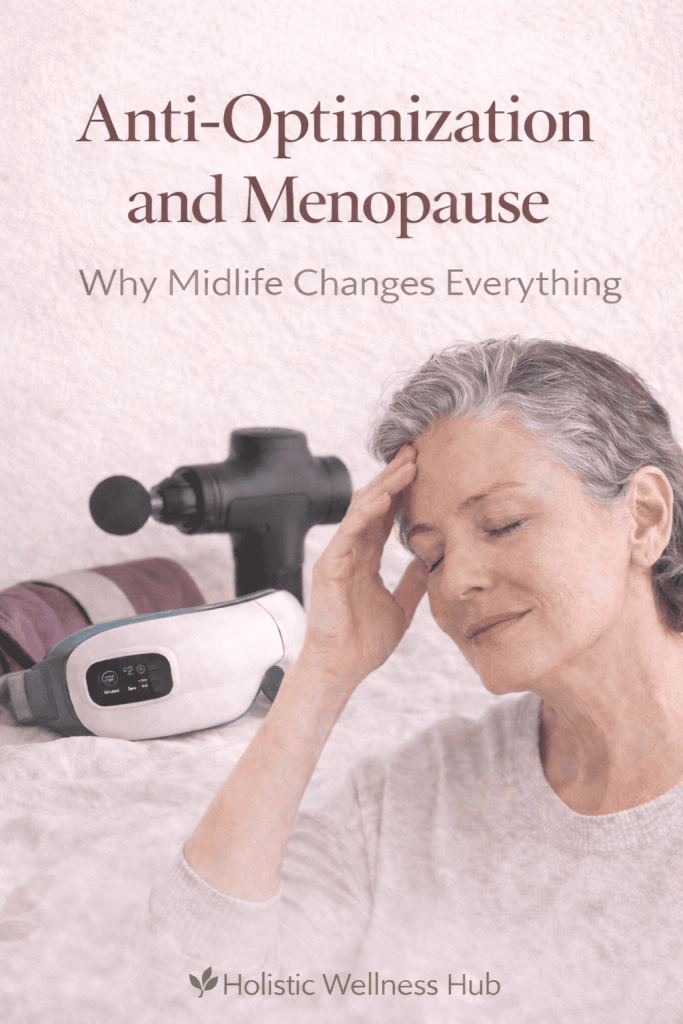

There is a quiet moment that many women experience in midlife.
You wake up tired — even after sleeping.
Your patience feels thinner.
Your stress tolerance feels smaller.
The routines that once energized you now exhaust you.
You begin to wonder:
Why can’t I handle what I used to?
Why does productivity feel harder?
Why does everything feel louder inside me?
And slowly, a deeper fear creeps in:
Am I burning out?
If you are navigating menopause and burnout simultaneously, please know this:
You are not broken.
You are recalibrating.
Midlife changes everything — not because you are weak, but because your body is evolving.
And optimization — the constant pressure to do more, be more, achieve more — stops working in this new season.

The Hidden Link Between Menopause and Burnout
Burnout in your 20s feels different.
You push through.
You recover faster.
You bounce back.
But menopause and burnout together create a different experience.
Hormones shift.
The nervous system becomes more sensitive.
Cortisol lingers longer in the bloodstream.
Sleep becomes lighter.
You are no longer operating with the same biological wiring.
Estrogen, progesterone, and cortisol are intricately connected to mood, resilience, sleep, and stress response. When estrogen fluctuates, the nervous system can become more reactive.
This is why:
-
You feel overwhelmed more easily
-
Stress feels heavier
-
Recovery takes longer
-
Emotional intensity increases
-
Productivity feels draining
This is not laziness.
This is physiology.
What Is Anti-Optimization?
Anti-optimization is not quitting ambition.
It is redefining sustainability.
Optimization culture teaches us:
-
Wake up earlier
-
Work harder
-
Maximize output
Supporting Your Body Without Forcing It
When we talk about menopause and burnout, we are not talking about “fixing” yourself.
We are talking about supporting your nervous system in a season of change.
Small physical rituals can anchor emotional stability. And when chosen intentionally, wellness tools become nervous system allies — not productivity enhancers.
Here are a few supportive categories to gently integrate into a midlife routine:
1. Heat for Hormonal Comfort
Warmth regulates the nervous system.
Infrared or gentle heating pads can:
-
Relax tight lower back muscles
-
Soothe abdominal discomfort
-
Reduce muscle guarding from chronic stress
-
Promote circulation before bed
Heat tells the body: You are safe enough to soften.
Used in the evening, it becomes a signal for sleep readiness — something many women struggle with during menopause.
2. Muscle Recovery to Lower Cortisol
Midlife tension accumulates faster — and releases slower.
Chronic muscle tightness keeps the nervous system in a low-level stress state.
Gentle recovery tools like massage therapy devices can:
-
Improve circulation
-
Decrease muscle tension
-
Support post-workout recovery
-
Lower stress signaling
When muscles soften, the brain often follows.
Burnout is not always mental. Sometimes it is trapped tension.
✨ Menopause Clarity Journal + Free Self‑Compassion Journal
Midlife clarity begins with self‑trust. The Menopause Clarity Journal helps you gently track your energy, emotions, sleep, and stress so you can finally understand your patterns and support your nervous system with intention.
To deepen that healing, you’ll also receive our Free Self‑Compassion Journal — a soft, reflective space to reconnect with your inner wisdom and create emotional spaciousness during menopause.
Together, these journals guide you from confusion to clarity, and from burnout to balance.
3. Evening Nervous System Rituals
Sleep disruption is one of the biggest complaints in menopause.
Creating a wind-down ritual may include:
-
Warm compress or eye relaxation tools
-
Light stretching
-
Soft lighting
-
Reduced screen time
-
Calm breathing
Consistency matters more than intensity.
The goal is not perfection — it is repetition.
Visit SproutHealth.co to shop our curated collection of wellness, home, beauty, fitness, and lifestyle essentials. Discover products that bring comfort, ease, and inspiration into your everyday life.
4. Hydration for Hormonal Stability
Dehydration worsens fatigue, headaches, irritability, and brain fog.
Midlife bodies are less forgiving when under-hydrated.
A consistent hydration ritual — especially in the morning — can:
-
Support metabolism
-
Reduce cortisol spikes
-
Improve skin elasticity
-
Increase mental clarity
The simpler the ritual, the more sustainable it becomes.
The 30-Day Midlife Reset Plan
Week 1: Stabilize Sleep
Focus:
-
Consistent bedtime
-
Evening wind-down ritual
-
Reduce stimulants after 2 PM
-
Gentle heat before bed
Goal: Improve sleep quality before changing anything else.
Sleep is the foundation of hormone regulation.
Week 2: Reduce Inflammation & Stress Load
Focus:
-
Remove one unnecessary commitment
-
Swap one high-intensity workout for a gentle one
-
Add daily stretching
-
Hydrate consistently
Goal: Lower cortisol burden.
You are not quitting discipline.
You are adjusting intensity.
Week 3: Emotional Awareness
Focus:
-
Journal energy patterns
-
Track mood fluctuations
-
Identify stress triggers
-
Notice when you feel most regulated
Goal: Awareness before action.
Midlife emotional wellness begins with pattern recognition.
Week 4: Redefine Productivity
Ask:
-
What actually matters right now?
-
What can be simplified?
-
What expectations are outdated?
-
What pace feels sustainable?
This is the heart of anti-optimization.
Productivity that costs your nervous system is not sustainable productivity.
FAQ Section
Can menopause make burnout worse?
Yes. Hormonal fluctuations reduce stress tolerance, making recovery from stress slower and emotional overwhelm more intense.
How long does menopause burnout last?
It varies. For some women, symptoms improve with lifestyle changes that support sleep, nervous system regulation, and hormone balance.
Can menopause cause anxiety and depression?
Hormonal shifts can influence mood stability. Anxiety, irritability, and low mood are common during perimenopause and menopause.
Why do I feel less motivated during menopause?
Lower progesterone and estrogen fluctuations can impact dopamine and serotonin, affecting motivation and focus.
Is it normal to feel emotionally overwhelmed in midlife?
Yes. Emotional intensity often increases due to hormonal changes and life-stage transitions.
What helps nervous system regulation during menopause?
-
Breathwork
-
Gentle exercise
-
Heat therapy
-
Muscle relaxation
-
Consistent sleep
-
Reduced overstimulation
Should I work less during menopause?
Not necessarily less — but differently. Sustainable pacing is often more effective than pushing through exhaustion.
Can stress make menopause symptoms worse?
Yes. Chronic stress elevates cortisol, which can intensify hot flashes, sleep disruption, and mood swings.
The Deeper Cultural Conversation
Midlife is not only biological — it is social.
Women in their 40s and 50s are often:
-
Caregivers
-
Professionals
-
Mothers
-
Leaders
Yet society still expects endless output.
Menopause exposes the flaw in that expectation.
Optimization assumes infinite stamina.
Biology disagrees.
And when women begin choosing slow living for women over 40, something radical happens:
They reclaim authority over their energy.
The Recalibration Phase
Menopause is a neurological remodeling process.
The brain literally adapts to lower estrogen levels.
This is not a decline.
It is restructuring.
Some women report:
-
Greater emotional clarity
-
Less tolerance for nonsense
-
Stronger boundaries
-
Deeper intuition
The exhaustion often precedes the empowerment.
Burnout is sometimes the bridge.
If You Are In the Middle of It
If you are waking up tired…
If your nervous system feels fragile…
If your ambition feels quieter…
If your productivity feels different…
Pause.
Instead of diagnosing yourself as failing, consider this:
Your body is negotiating a new contract.
And the terms are:
-
Sustainability
-
Restoration
-
Alignment
-
Emotional truth
Midlife Is Not the End of Drive
It is the end of self-abandonment.
You may work differently.
You may move differently.
You may schedule differently.
But you are not shrinking.
You are refining.
Download here: It’s free
👉 Holistic Wellness Hub – Midlife Nervous System Reset Bundle
Closing Reflection
Menopause and burnout together can feel frightening.
But what if they are not signs of collapse?
What if they are signals of recalibration?
Optimization worked when your hormones supported a relentless pace.
Now your biology asks for collaboration.
And when you answer that call gently, something powerful happens:
You build a life that your nervous system can actually sustain.
Not louder.
Not faster.
But steadier.
And that kind of strength — quiet, regulated, self-aware — is the most resilient form of power there is.