

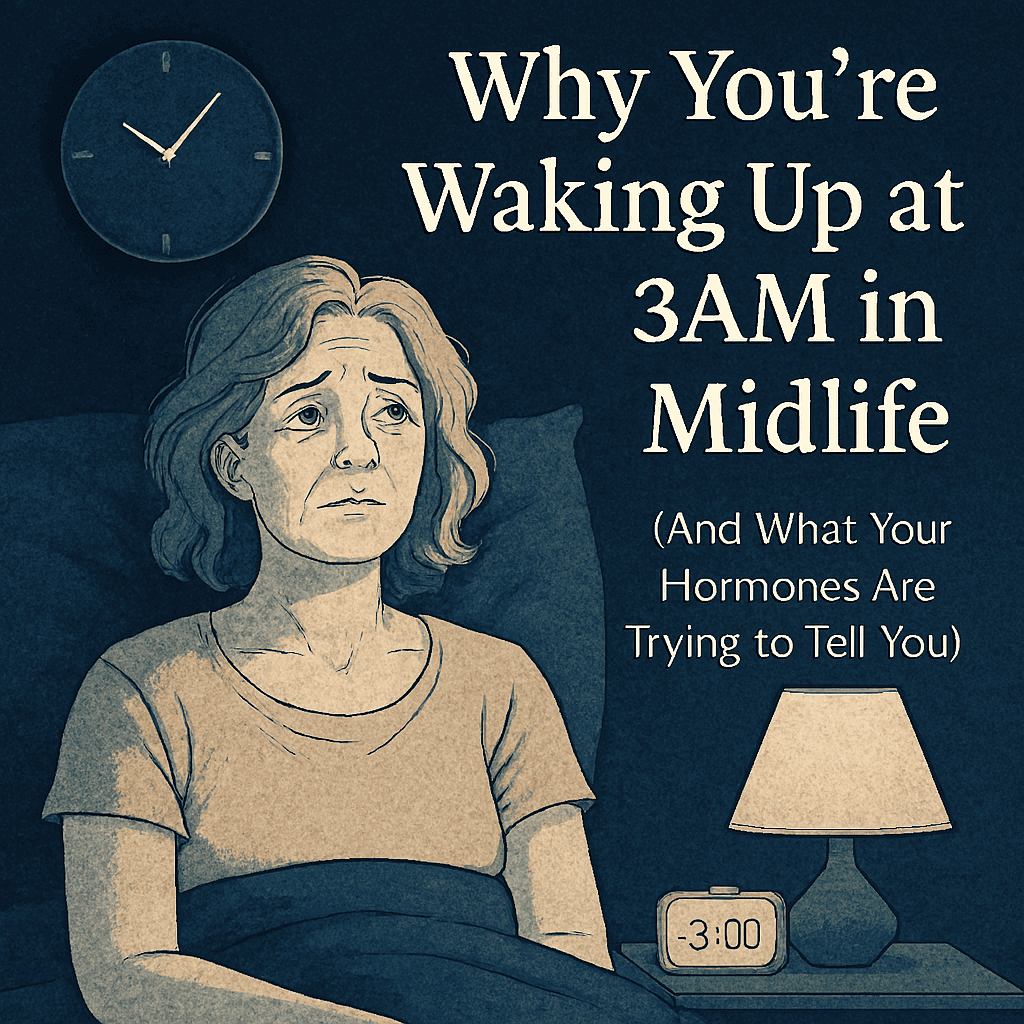

There is a quiet hour in midlife that so many women know intimately.
It’s 3:07 AM. Or 2:43 AM. Or 3:18 AM.
Your eyes open. Your body is tired — but your mind is suddenly wide awake.
You stare at the ceiling. Your heart feels a little faster. Thoughts begin lining up: your children, your work, your aging parents, your health, the future.
And you wonder:
Why am I waking up at 3 AM every night? Is this perimenopause? Is this anxiety? Why can’t I fall back asleep? Will this ever stop?
If you wake up at 3 AM in midlife, you are not broken. You are not weak. You are not “just stressed.”
Your body is communicating.
Let’s gently listen.
What’s Actually Happening When You Wake Up at 3 AM?
Your body runs on a circadian rhythm — a 24‑hour internal clock that regulates sleep, hormones, body temperature, and energy. In a healthy rhythm:
- Melatonin rises at night
- Cortisol stays low
- Blood sugar remains stable
- Your nervous system shifts into repair mode
But in midlife, several systems begin shifting at once.
Hormonal changes disrupt sleep architecture
Research shows that 40–60% of women experience sleep disturbances during perimenopause. These disruptions often begin before periods become irregular.
Estrogen and progesterone — the hormones that once supported deep, stable sleep — begin fluctuating unpredictably.
This affects:
- Melatonin production
- Cortisol timing
- Blood sugar stability
- Emotional regulation
- Nervous system sensitivity
And suddenly, 3 AM becomes a fragile hour.
Cortisol and the 3 AM Wake-Up
One of the most common reasons women wake up at 3 AM in midlife is early cortisol release.
Cortisol is not the enemy. It’s your survival hormone — the one that wakes you up in the morning.
But during perimenopause:
- Estrogen fluctuations affect cortisol regulation
- Chronic stress makes cortisol spike earlier
- Blood sugar dips trigger adrenaline
- Nighttime cortisol becomes elevated
Dr. Jolene Brighten notes that nighttime cortisol spikes are a major cause of 2–4 AM wake-ups in perimenopause.
This creates the sensation many women describe as:
Your body is tired. Your mind is alert. Your hormones are confused.
Why Your Mind Races at 3 AM
This is one of the most searched questions related to perimenopause sleep problems.
Here’s what’s happening:
- Lower progesterone reduces the natural calming effects
- Estrogen fluctuations affect serotonin and GABA
- Cortisol rises too early
- The brain shifts into problem‑solving mode
At night, without distractions, unresolved emotions rise to the surface.
Midlife is emotionally dense. You may be:
- Supporting teenagers
- Caring for aging parents
- Managing career pressure
- Facing identity shifts
- Questioning your pace and purpose
At 3 AM, the nervous system doesn’t filter. It amplifies.
Why This Starts in Your 40s (Even If You Slept Fine Before)
Many women ask:
“Why did I suddenly start waking up at 3 AM at 42/45/48?”
Because perimenopause begins long before menopause.
Hormones don’t decline smoothly. They fluctuate — sometimes wildly.
Research shows that estrogen and progesterone fluctuations directly disrupt sleep architecture.
This leads to:
- Lighter sleep
- Night sweats
- Temperature dysregulation
- Anxiety spikes
- Early waking
Even women who were “great sleepers” for decades can suddenly experience perimenopause insomnia.
🌿 Explore the SproutHealth Wellness Shop
Visit SproutHealth.co
to shop our curated collection of wellness, home, beauty, fitness, and lifestyle essentials.
Discover thoughtful products designed to bring comfort, ease, and inspiration into your everyday life.
Is Waking at 3 AM Anxiety or Hormones?
The truth is: it’s often both.
Hormones influence the nervous system. The nervous system influences anxiety. Anxiety influences sleep.
Estrogen helps regulate serotonin. Progesterone has a calming, GABA‑like effect.
When these fluctuate:
- Small worries feel big
- Normal life feels overwhelming
- Your body feels “on edge.”
You’re not imagining it. This is midlife hormonal recalibration.
Blood Sugar and the 3 AM Spike
Here’s something many women don’t realize:
Waking at 3 AM can be blood sugar-related.
As insulin sensitivity changes in midlife:
- A high‑carb dinner can spike glucose
- Blood sugar drops overnight
- The body releases adrenaline to raise its levels
- You wake up
Research confirms that blood sugar instability can trigger nighttime awakenings in perimenopause.
This is why alcohol often makes waking at 3 AM worse.
The Nervous System in Midlife: Why Optimization Stops Working
If you’ve followed productivity systems or “optimize your sleep” protocols, you may feel frustrated that they aren’t working anymore.
Midlife changes the rules.
Your nervous system becomes less tolerant of:
- Chronic stress
- Over‑exercising
- Undereating
- Constant stimulation
- Achievement‑driven pace
This is why many women experience both menopause and burnout together.
You can’t discipline your way out of a hormonal transition. You need regulation, not optimization.
Why It’s Always the Same Time
Many women ask:
“Why do I wake up at exactly 3 AM every night?”
Your body thrives on rhythm — even dysfunctional rhythm.
If cortisol begins rising early repeatedly, it trains the brain to anticipate waking.
It becomes a conditioned stress response.
The solution isn’t panic. It’s retraining safety.
Does Magnesium Help?
Magnesium glycinate can support:
- Relaxation
- Muscle tension reduction
- Nervous system calming
But supplements alone rarely solve the issue.
Because 3 AM waking is rarely just a deficiency. It’s usually:
- Hormonal fluctuation
- Nervous system overload
- Emotional accumulation
- Blood sugar instability
- Life pace mismatch
Supplements support. They don’t override lifestyle signals.
Does HRT Fix 3 AM Waking?
Hormone Replacement Therapy can improve sleep for some women, especially when progesterone is included.
But it is not a guaranteed cure.
Some women still need:
- Nervous system support
- Stress reduction
- Blood sugar regulation
- Emotional processing
HRT addresses hormone levels. It doesn’t erase life stress.
Always consult your healthcare provider when considering hormone therapy.
Why You Can’t Fall Back Asleep
Once awake, your brain enters problem‑solving mode.
Trying to “force sleep” increases cortisol.
Instead:
- Avoid checking the time
- Avoid scrolling
- Practice slow breathing
- Keep the lighting dim
- Use a bedside journal to offload thoughts
Sometimes, simply telling your nervous system:
“I am safe. There is no emergency.”
Is enough to lower the alert state.
What Your 3 AM Wake-Up Might Be Telling You
This is the deeper truth.
Midlife waking isn’t just hormonal. It’s informational.
Your body may be asking for:
- A slower pace
- More protein and nourishment
- Less alcohol
- Fewer commitments
- More boundaries
- Emotional release
- Gentle strength training
- Sunlight exposure
- A redefinition of productivity
Midlife is not decline. It is recalibration.
A Gentle 3 AM Reset Framework: The CALM Method
C – Cortisol Awareness
Protect your evenings. Reduce stimulation. Dim the lights early.
A – Align with Hormones
Eat protein‑rich meals. Lift weights 2–3 times weekly. Get morning sunlight.
L – Lower Nervous System Load
Say no more often. Schedule recovery. Practice breathwork.
M – Make Space for Emotional Processing
Journal. Talk. Reflect. Release.
A Practical Evening Routine for Women Over 40
A gentle routine can support your circadian rhythm:
- Protein + healthy fat snack before bed
- Magnesium glycinate (if appropriate)
- Dim lighting after 8 PM
- No doom scrolling
- Warm shower or heat therapy
- Bedside journal for mental unloading
Consistency matters more than perfection.
When to Seek Medical Support
If 3 AM waking is accompanied by:
- Severe anxiety
- Heart palpitations
- Heavy night sweats
- Unexplained weight changes
- Depression symptoms
- Loud snoring or gasping
- Thyroid symptoms
Speak to your healthcare provider.
Midlife transitions deserve medical partnership, not dismissal.
How Long Does 3 AM Waking Last?
For many women, it fluctuates throughout perimenopause (4–10 years).
But intensity often reduces when:
- Hormones stabilize
- Stress load decreases
- Nervous system regulation improves
- Lifestyle aligns with midlife physiology
You are not doomed to insomnia forever.
The Emotional Truth of 3 AM
There is something sacred about the quiet hour.
Midlife is often the first time women stop running.
At 3 AM, you are forced to sit with yourself.
Sometimes the wake‑up isn’t about hormones alone. It’s about:
- Grief, you haven’t processed
- Dreams you postponed
- Identity shifts you resisted
- Boundaries you didn’t set
The body speaks when the day is silent.
And instead of fighting it, you can ask:
“What are you trying to teach me?”
Menopause Clarity Journal + Free Self‑Compassion Journal

Midlife clarity begins with self‑trust. The Menopause Clarity Journal helps you gently track your energy, emotions, sleep, and stress so you can understand your patterns and support your nervous system with intention.
To deepen that healing, you’ll also receive our Free Self‑Compassion Journal — a soft, reflective space to reconnect with your inner wisdom.
Together, these journals guide you from confusion to clarity, and from burnout to balance.
Closing: Your Body Is Not Betraying You
Waking up at 3 AM in midlife is not a weakness. It’s wisdom asking for adjustment.
Your hormones are shifting. Your nervous system is recalibrating. Your life pace is being renegotiated.
You don’t need more discipline. You need more alignment.
You don’t need to optimize. You need to soften.
Midlife doesn’t whisper. It wakes you up.
And when you listen gently, sleep returns in its own time.
Download the Free 3 AM Midlife Sleep Reset Guide
Let this be something you reach for on the nights when you wake — not to fix yourself, but to support yourself.