

Modern productivity promises control, efficiency, and endless optimization.
But for many women — especially in midlife — productivity often feels less like empowerment and more like quiet exhaustion.
The to-do lists grow longer.
The expectations become heavier.
And the feeling of “never doing enough” quietly settles into daily life.
If you have ever opened your planner and felt an immediate wave of overwhelm, you are not alone.
Many women are trying to live inside productivity systems that were never designed for the rhythms of real life — systems that ignore emotional energy, hormonal shifts, caregiving responsibilities, and the invisible mental load women often carry.
This is where a gentler approach becomes not only helpful, but necessary.
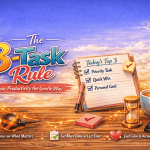
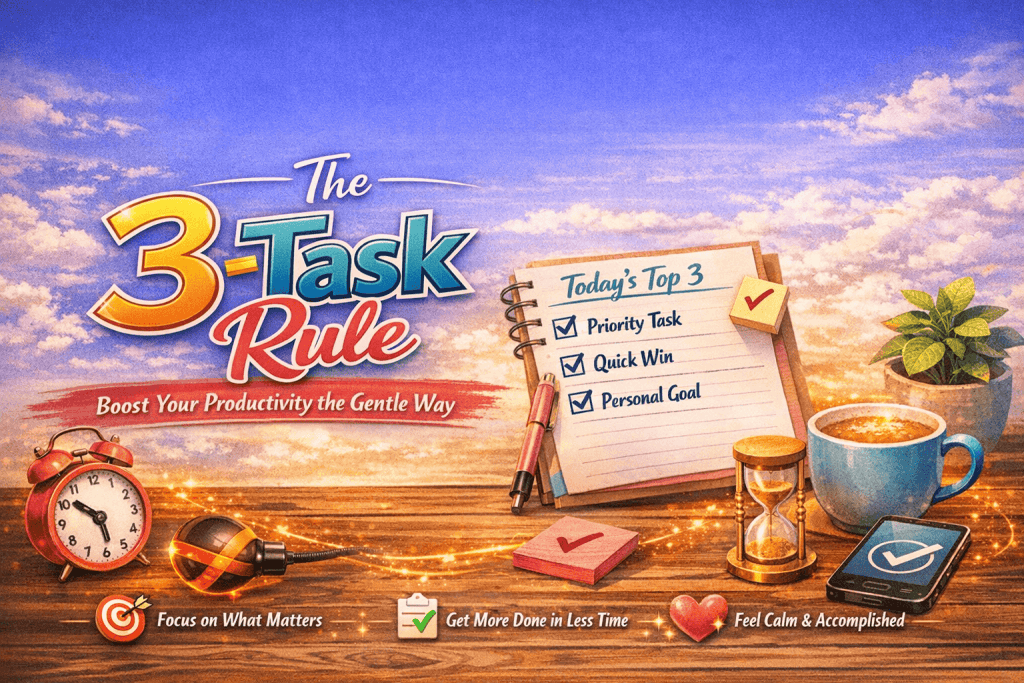
One simple method that has helped many people reclaim calm and focus is something called the 3-Task Rule.
It is exactly what it sounds like.
Instead of writing endless to-do lists, you choose only three meaningful tasks for the day.
Three.
Not fifteen.
Not twenty.
Just three.
This small shift can transform not only how your days feel, but how you relate to productivity itself.
Within the philosophy I teach on this blog — the Swarnambal Soft Living Framework — the 3-Task Rule becomes a practical way to honor energy, presence, and emotional wellbeing without abandoning meaningful goals.
In a world obsessed with doing more, this gentle rule invites us to remember something powerful:
Sometimes doing less allows us to live more deeply.
What Is the 3-Task Rule?
At its heart, the 3-Task Rule is beautifully simple.
Each day, you choose three types of tasks:
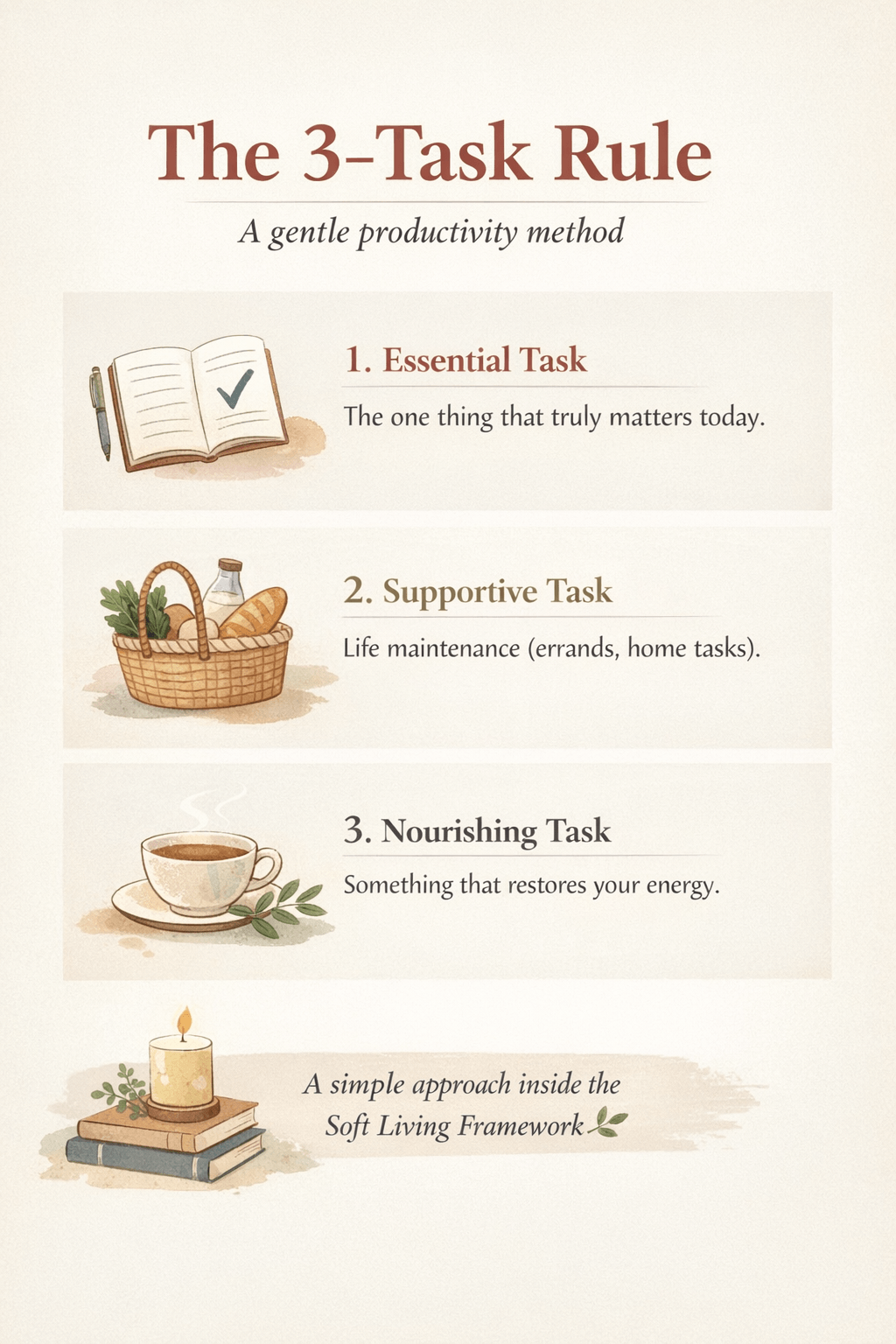
1 Essential Task
1 Supportive Task
1 Nourishing Task
Instead of filling your schedule with dozens of obligations, you intentionally choose a small number of meaningful actions.
By the end of the day, completing these three tasks means your day has been successful.
This approach shifts productivity away from endless output and toward intentional living.
The structure might look like this:
Essential Task
Complete a work project or important responsibility.
Supportive Task
Handle a practical life task such as groceries, laundry, or appointments.
Nourishing Task
Do something that supports your emotional or physical wellbeing.
This final category is where the 3-Task Rule becomes particularly powerful.
Many productivity systems leave no room for rest, reflection, or emotional care. Yet these are the very things that sustain our energy over time.
A nourishing task might be:
• a quiet morning walk
• journaling
• stretching or gentle yoga
• reading a chapter of a book
• preparing a calming cup of tea
By including nourishment in your daily structure, productivity becomes supportive rather than draining.
Why Traditional Productivity Systems Burn Women Out
Many productivity systems were created in environments focused on efficiency, output, and measurable performance.
While these systems can be helpful in certain contexts, they often ignore the complexity of real human lives.
Women frequently balance multiple invisible responsibilities:
• emotional caregiving
• family coordination
• household management
• professional expectations
• community roles
On top of this, midlife brings its own set of transitions.
Hormonal shifts during perimenopause and menopause can affect:
• sleep patterns
• cognitive clarity
• emotional sensitivity
• physical energy levels
Yet the cultural message remains the same: do more, faster, better.
This constant pressure contributes to what many experts now describe as hustle culture burnout.
If you have ever felt like productivity advice simply makes you feel more overwhelmed, it may not be because you lack discipline.
It may simply be that the system was never designed with your life in mind.
This is why gentler approaches like gentle productivity are gaining attention.
Instead of forcing ourselves into rigid structures, we begin to create rhythms that honor our energy, emotions, and real capacity.

✨ Menopause Clarity Bundle
Get the Menopause Clarity Bundle today for just $3.99 —
Your gentle guide to understanding your body with confidence, tracking symptoms,
and navigating menopause with more calm, clarity, and self-compassion.
The Science Behind Small To-Do Lists
There is also a cognitive reason why shorter task lists work better.
Our brains are not designed to process endless streams of decisions.
Psychologists often refer to something called decision fatigue.
Every time we decide what to do next, our mental energy is slightly reduced.
When a to-do list contains fifteen or twenty items, the brain begins to experience a subtle sense of overwhelm before the day even begins.
Shorter lists provide a different experience.
They create clarity.
They reduce mental noise.
They make it easier for the brain to focus deeply on the task at hand.
There is also a small neurological reward involved.
Each time we complete a meaningful task, the brain releases a small amount of dopamine — a neurotransmitter associated with motivation and satisfaction.
When a list is too long, tasks remain unfinished and the brain registers the day as incomplete.
When the list is intentionally small, completion becomes possible.
Completion builds momentum.
Momentum builds confidence.
And confidence makes it easier to begin again tomorrow.
🌿 Explore the SproutHealth Wellness Shop
Visit SproutHealth.co
to shop our curated collection of wellness, home, beauty, fitness, and lifestyle essentials.
Discover thoughtful products designed to bring comfort, ease, and inspiration into your everyday life.
The Three Types of Tasks That Make the Rule Work
The magic of the 3-Task Rule is not simply the number three.
It is the balance between different types of activity.
The Essential Task
This is the one task that truly matters today.
It might be something related to your work, personal goals, or responsibilities that cannot easily be postponed.
Examples might include:
• finishing an important report
• attending a medical appointment
• submitting an application
• completing a meaningful project
If this task is finished, the day has already moved forward in a meaningful way.
The Supportive Task
Life requires maintenance.
Meals must be prepared, homes cared for, errands handled, and practical matters addressed.
The supportive task keeps daily life running smoothly.
Examples might include:
• grocery shopping
• organizing paperwork
• doing laundry
• scheduling appointments
By intentionally choosing just one supportive task, we prevent daily maintenance from taking over the entire day.
The Nourishing Task
This is the category many productivity systems ignore.
And yet it may be the most important.
Nourishing tasks replenish emotional and physical energy.
Examples include:
• a quiet walk in nature
• meditation or breathwork
• journaling
• stretching
• reading for pleasure
These moments of gentle care remind us that life is not simply a sequence of responsibilities.
It is also a series of experiences.
Why the 3-Task Rule Is Especially Helpful in Midlife
Many women notice a shift in their relationship with productivity as they move through midlife.
The strategies that once worked effortlessly may begin to feel draining or unrealistic.
Hormonal changes can influence concentration, sleep quality, and emotional sensitivity.
At the same time, midlife often includes additional responsibilities such as caregiving for children, supporting aging parents, and navigating career transitions.
In this season of life, productivity needs to become energy-aware.
Rather than forcing ourselves to maintain constant output, we begin to work with our natural rhythms.
Some days bring clarity and focus.
Other days require gentleness and rest.
The 3-Task Rule respects this reality.
It creates a structure that is supportive rather than demanding.
Even on days when energy is limited, completing three intentional tasks allows progress to continue without overwhelming the nervous system.
Common Mistakes People Make With the 3-Task Rule
Like any simple system, the 3-Task Rule works best when approached with flexibility and self-compassion.
One common mistake is choosing tasks that are too large.
If a task requires many hours or multiple steps, it may be helpful to break it into smaller actions.
Another mistake is quietly turning three tasks into ten subtasks.
The purpose of the rule is simplicity.
When the list grows again, the feeling of overwhelm returns quickly.
A third mistake is skipping the nourishing task.
It can feel tempting to replace this with another productive activity.
But the nourishing task is what keeps the system sustainable.
Finally, many women struggle with guilt.
Even after completing the three tasks, the mind may whisper that more should have been done.
This is where a deeper shift in perspective becomes important.
The Swarnambal Soft Living Framework
Over the years of writing about emotional wellness, midlife transitions, and burnout recovery, I began noticing a pattern.
Women were not failing in productivity.
Productivity was failing women.
The systems we were taught prioritized efficiency and output, but rarely acknowledged emotional wellbeing, hormonal rhythms, or the deep need for rest and presence.
This realization gradually shaped what I now call the Soft Living Framework.
It is not a strict method or rigid formula.
Instead, it is a gentle philosophy for living with greater compassion and awareness.
The framework is built around three simple principles.
Permission Over Perfection
Many women carry an invisible expectation to do everything perfectly.
Soft living invites us to replace perfection with permission.
Permission to rest.
Permission to move slowly.
Permission to change pace during different seasons of life.
Energy Over Efficiency
Traditional productivity asks:
“How quickly can this be completed?”
Soft living asks a different question:
“What does my body have the capacity for today?”
By listening to our energy instead of constantly pushing against it, we create a more sustainable relationship with work and life.
Presence Over Productivity
Perhaps the most important shift is remembering that life is not measured only by output.
Moments of presence — conversations, quiet reflection, time spent in nature — often hold the deepest meaning.
The 3-Task Rule fits beautifully within this philosophy.
It offers a practical way to honor energy and presence while still moving forward with intention.
A Simple Daily 3-Task Template
If you would like to try the 3-Task Rule, you might begin with a small daily ritual.
Each morning, or the night before, write down three intentions for the day.
Essential Task
Supportive Task
Nourishing Task
That is all.
Close the planner.
Let the rest of the day unfold naturally.
You may be surprised by how much clarity this small structure creates.
Tools That Can Support Gentle Productivity
Many women find it helpful to pair the 3-Task Rule with simple reflection tools.
Journals, planners, and gentle daily check-ins can provide space to notice patterns in energy and emotional wellbeing.
For example, a menopause symptom tracker or a self-compassion journal can help women observe how sleep, stress, and hormonal changes influence daily capacity.
Over time, these small observations build a deeper understanding of what the body truly needs.
Productivity then becomes less about control and more about alignment.
Feeling overwhelmed by long to‑do lists? Wish your days felt calmer, clearer, and more intentional?
I created a gentle, printable 3‑Task Planner to help you focus on what truly matters — without burnout or pressure.
📝 What you’ll get: • 1 Essential Task • 1 Supportive Task • 1 Nourishing Task A simple, soothing structure that brings clarity and balance to your day.
💛 It’s completely FREE — download your copy now and start your soft productivity journey.
👉 Click to download your printable planner
Final Thoughts: Living a Non-Optimized Life
The world often tells us that life should be optimized.
More efficiency.
More productivity.
More output.
But many women are discovering that constant optimization quietly erodes joy.
The 3-Task Rule offers a different path.
A slower path.
A more intentional path.
It reminds us that meaningful days are not defined by endless accomplishments.
Sometimes a good day looks like this:
You finished one important task.
You cared for your home or responsibilities.
And you cared for yourself.
That is not laziness.
That is balance.
In a culture that celebrates exhaustion, choosing a softer rhythm can be a quiet act of courage.
And sometimes, three meaningful tasks are more than enough.